What is sustainable farming?
Long term farm sustainability and economic production can only be maintained if farms reflect natural ecosystems. The concept of regenerative agriculture is alien to many, but in Australia, farm management has frequently adapted to changes in commodity prices, markets, climatic and natural resource conditions. Natural ecosystems are extremely resilient and utilise only renewable inputs. Over thousands of years they have shown high productivity, an ability to maintain environmental quality and adaptivness to any natural disturbance. By weaving together the elements of microclimate, annual and perennial plants, water and soil management with human needs, environmental and hollistic farming systems have been shown to be energy efficient and high yielding. An accepted definition of sustainable farming, is an integrated system of plant and animal production having a site-specific application that will, over the long term:
Our property is ecologically important because it is a vegetated link between the Grantville Flora & Fauna Reserve and the Bass River and forms part of the only riparian forest left on the river.
Farm activities were designed to minimise off-site and on-site impacts. All creek lines are vegetated to maintain water quality run off into the Bass. A study backed by the Federal Government's Envirofund program found that free range farming practices are viable and have minimal impacts on the environment.
The study, carried out on five properties in the Port Phillip and Westernport Catchment Authority area showed that properly managed free range egg farms have many benefits - including long term sustainability.
The Freeranger Farm was one of the participants and we believe that low density production is the key to sustainability. "It doesn't make any real difference whether you are running cattle, sheep or chickens, if the stocking rate is too high you will run into trouble" is our philosophy.
It's hard to justify European farming practices in many parts of Australia - they simply don't work with our soil types and climate. The current drought is a clear example of the stupidity in trying to maintain exotic pastures and growing crops which require huge and unsustainable inputs.
Apart from the massive problems of erosion and salinity, the inputs needed to maintain unrealistically high production levels create unhealthy nutrient loads and reduce farm viability over the years.
The report demonstrates that stocking densities have a direct impact on feed costs. Supplementary feed inputs rose significantly as stocking rates increased.
Once the results were produced in table form it was easy to see that a free range egg farm with a stocking rate of 9 Dry Sheep Equivalent (DSE) per hectare, produced an egg laying rate of 70% with feed consumption of 26 kg per bird per year. A farm with a stocking rate of 75 DSE per hectare produced a lay rate of 65% with feed consumption almost double at 48 kg per bird.
At current prices that's an added cost of nearly $10 a year for each bird - which doesn't sound much until you multiply it over the whole flock. The Freeranger Farm is at the most productive end of the scale.
Pasture management here has been aimed at increasing the amount of native grasses in the vegetated cover. The report shows that soils on the farm are acidic and have relatively low nutrient levels.
We regarded it as counter productive to try to change the soil balance to favour exotic grasses and a management style was chosen with a preference for adapting farm practices to fit the natural soil types on this farm.
Microlaena stipoides is one of Australia's most important native grasses with a widespread distribution in the eastern States. Its bright green colour, drought and frost resistance as well as shade tolerance make it superior to any non-native species as it has evolved for thousands of years in the dry and unpredictable Australian climate.
It is easily out-competed by exotic grasses in neutral or alkaline soil conditions, preferring acidic soils like those at Grantville. During the trial, lime was only applied to small test sites. The majority of the pasture had no inputs other than chicken manure from the free-ranging hens and native grass coverage increased by about 25%. There was also a high level of activity by earthworms and dung beetles.
We appear to have at least two types of dung beetles on the property because there is evidence of activity all year round and some species are known to be dormant over winter.
The farm is a member of the Western Port Biosphere Reserve.
Deep Ecology
management practices reflect our view that our activities must have minimal negative impacts. We are a part of the environment, not apart from it.
- satisfy human food and fibre needs;
- enhance environmental quality and the natural resource base upon which agricultural economies depend;
- make the most efficient use of non-renewable resources and on-farm resources and integrate, where appropriate, natural biological cycles and controls;
- sustain the economic viability of farm operations; and
- enhance the quality of life for farmers and society as a whole
Our property is ecologically important because it is a vegetated link between the Grantville Flora & Fauna Reserve and the Bass River and forms part of the only riparian forest left on the river.
Farm activities were designed to minimise off-site and on-site impacts. All creek lines are vegetated to maintain water quality run off into the Bass. A study backed by the Federal Government's Envirofund program found that free range farming practices are viable and have minimal impacts on the environment.
The study, carried out on five properties in the Port Phillip and Westernport Catchment Authority area showed that properly managed free range egg farms have many benefits - including long term sustainability.
The Freeranger Farm was one of the participants and we believe that low density production is the key to sustainability. "It doesn't make any real difference whether you are running cattle, sheep or chickens, if the stocking rate is too high you will run into trouble" is our philosophy.
It's hard to justify European farming practices in many parts of Australia - they simply don't work with our soil types and climate. The current drought is a clear example of the stupidity in trying to maintain exotic pastures and growing crops which require huge and unsustainable inputs.
Apart from the massive problems of erosion and salinity, the inputs needed to maintain unrealistically high production levels create unhealthy nutrient loads and reduce farm viability over the years.
The report demonstrates that stocking densities have a direct impact on feed costs. Supplementary feed inputs rose significantly as stocking rates increased.
Once the results were produced in table form it was easy to see that a free range egg farm with a stocking rate of 9 Dry Sheep Equivalent (DSE) per hectare, produced an egg laying rate of 70% with feed consumption of 26 kg per bird per year. A farm with a stocking rate of 75 DSE per hectare produced a lay rate of 65% with feed consumption almost double at 48 kg per bird.
At current prices that's an added cost of nearly $10 a year for each bird - which doesn't sound much until you multiply it over the whole flock. The Freeranger Farm is at the most productive end of the scale.
Pasture management here has been aimed at increasing the amount of native grasses in the vegetated cover. The report shows that soils on the farm are acidic and have relatively low nutrient levels.
We regarded it as counter productive to try to change the soil balance to favour exotic grasses and a management style was chosen with a preference for adapting farm practices to fit the natural soil types on this farm.
Microlaena stipoides is one of Australia's most important native grasses with a widespread distribution in the eastern States. Its bright green colour, drought and frost resistance as well as shade tolerance make it superior to any non-native species as it has evolved for thousands of years in the dry and unpredictable Australian climate.
It is easily out-competed by exotic grasses in neutral or alkaline soil conditions, preferring acidic soils like those at Grantville. During the trial, lime was only applied to small test sites. The majority of the pasture had no inputs other than chicken manure from the free-ranging hens and native grass coverage increased by about 25%. There was also a high level of activity by earthworms and dung beetles.
We appear to have at least two types of dung beetles on the property because there is evidence of activity all year round and some species are known to be dormant over winter.
The farm is a member of the Western Port Biosphere Reserve.
Deep Ecology
management practices reflect our view that our activities must have minimal negative impacts. We are a part of the environment, not apart from it.
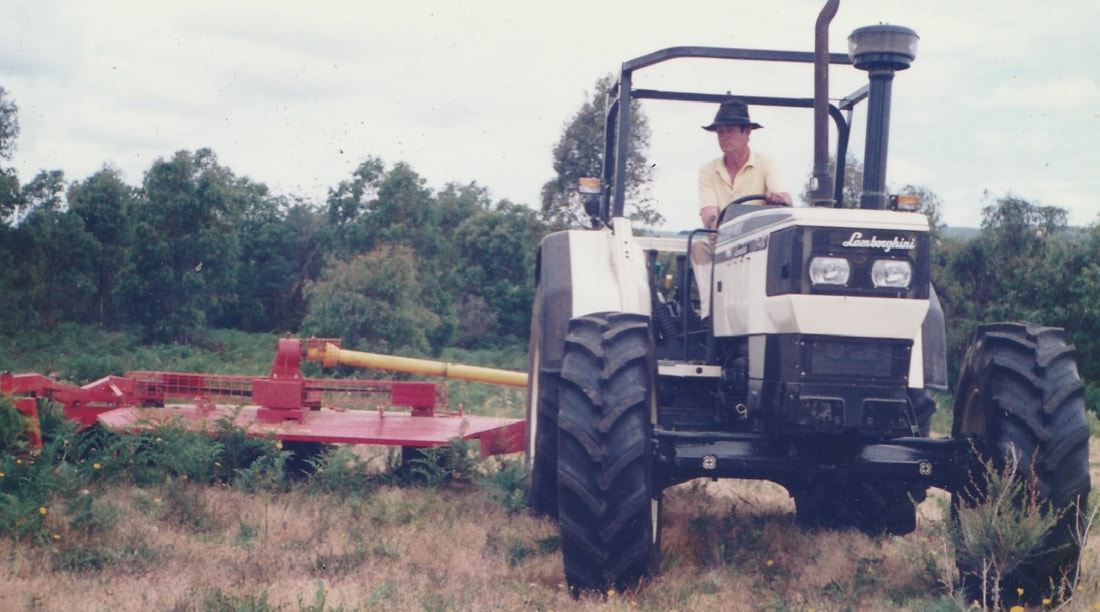
Preparing the land to establish pasture
Why we do what we do at Freeranger Eggs
When we bought our property on the Bass River at Grantville, we soon realised its importance as part of the only remaining riparian forest on the river. Our vegetation also provided the only link between the Grantville Flora and Fauna Reserve and the Bass. Once that was firmly established in our minds we set about ensuring that production on Blue Mountain Creek became not only sustainable but renewable.
Self-renewing topsoil that is biologically active is essential for productive agriculture as well as a healthy environment. It is the over-riding requirement for the health of plants, animals and people. But unfortunately it's not something that's high on the radar of most farmers.
Appropriate management of soil biology in agriculture, horticulture, forestry and conservation areas is hard to find and is one of the most neglected natural resource issues in Australia. Most of our grasslands and croplands are nowhere near as healthy as they should be.
They often feature areas of bare ground, sheet and gully erosion, weeds and an almost complete lack of desirable plant species. It's an easy but gullible assumption that removing the weeds and replanting some 'better' species will solve the problems. Decades of experience have demonstrated that this simplistic approach rarely works.
The interactions between animals, plants and soil biota remain out of balance because the essential requirement of soil management has not been addressed. The consequent shortfall in ecosystem services, such as nutrient availability, results in costly (and damaging) supplements being added to the soils.
Landscapes are not degraded because they lack desirable species. The reality is that desirable species will not flourish when landscapes are degraded.
In agriculture, grazing and cropping account for most of the land use. If we can get our resource managers (and farmers) to recognise that the main focus of natural resource management needs to be to maintain high levels of humic materials to rebuild topsoil, we will see some top results. But it will require radical departures from conventional methods of production.
Regenerative Farm Practices
The business of farming can be productive, restorative and profitable provided it: -
- regenerates, rather than merely 'sustains' the natural resource base
- enhances, rather than replaces natural ecosystem processes
- stimulates the formation, rather than attempt to reduce the loss, of
topsoil.
When agriculture is regenerative, soils, vegetation and productivity continually improve rather than stagnate or slowly degenerate. It also improves water quality in our catchments.
Regenerative agriculture is productive and profitable. It generates a sense of personal satisfaction in farmers and rural communities. Revitalising the natural resource base gives us all hope and improves our sense of place in the environment – after all, we are part of it.
The philosophy of enhancement
The traditional approach to land management has been to replace native vegetation with something that is 'more productive' (using exotic species and unbalanced chemical fertilisers) rather than adopting a multi-level, multispecies approach. There have been cosmetic attempts to make oversimplified ecosystems 'sustainable'. But it is a battle which cannot be won.
Until a preventative rather than a curative approach to land management is adopted, agricultural ‘problems’ such as soil compaction, low fertility, weeds, pests and diseases, salinity etc, will continue indefinitely.
Why spend buckets of money every year trying to change the soil balance or structure to meet the needs of exotic plant species (such as rye grass and clover) when there are perfectly adequate native species (such as miocrolaena stipoides) which thrive in low ph soils and out-perform the exotics in dry years.
The more components in an ecosystem, the greater the synergy between them. Improving the diversity and health of agricultural landscapes means we need to think creatively and change the way we have chosen to do things. Why continue trying to replace natural biological processes with expensive technology, synthetic fertilisers, cocktails of chemicals and genetically modified species?
For some, it is difficult to step off the replacement treadmill, because nutrient acquisition and distribution no longer occur naturally in dysfunctional soils. However, production costs spiral inexorably upwards for as long as the replacement philosophy endures– and agriculture in Australia and many other parts of the world becomes increasingly unviable.
Food security is the next 'Big Thing' because of our stupidity
Adapted from an article by Lester Brown of the Earth Policy Institute
Food security is emerging as a massive threat to the world’s population. Unsustainable farming practices are making the problem worse - which is the main reason we demonstrate how things can be done better at the Freeranger farm.
At a time when the world’s farmers are facing a record growth in food demand, they continue to wrestle with the traditional threats to production such as soil erosion. But now they are also looking at three new challenges on the production front. One, aquifers are being depleted and irrigation wells are starting to go dry in 18 countries that together contain half the world’s people. Two, in some of the more agriculturally advanced countries, rice and wheat yield per acre, which have been rising steadily for several decades, are beginning to plateau. And three, the earth’s temperature is rising, threatening to disrupt world agriculture in scary ways.
The countries where water tables are falling and aquifers are being depleted include the big three grain producers—China, India, and the United States. World Bank data for India indicate that 175 million people are being fed with grain produced by overpumping. My own estimate for China is that 130 million people are being fed by overpumping. In the United States, the irrigated area is shrinking in leading agricultural states such as California and Texas as aquifers are depleted and irrigation water is diverted to cities.
Second, after several decades of rising grain yields, some of the more agriculturally advanced countries are hitting a glass ceiling, a limit that was not widely anticipated. Rice yields in Japan, which over a century ago became the first country to launch a sustained rise in land productivity, have not increased for 17 years. In both Japan and South Korea, yields have plateaued at just under 5 tons per hectare. China’s rice yields, rising rapidly in recent decades, are now closely approaching those of Japan. If China cannot raise its rice yields above those in Japan, and it does not seem likely that it can, then a plateauing there too is imminent.
A similar situation exists with wheat yields. In France, Germany, and the United Kingdom—the three leading wheat producers in Europe—there has been no rise for more than a decade. Other advanced countries will soon be hitting their glass ceiling for grain yields. Australia is no exception.
The third new challenge confronting farmers is global warming. The massive burning of fossil fuels is increasing the level of carbon dioxide in the atmosphere, raising the earth’s temperature and disrupting climate. It is now in a state of flux. Historically when there was an extreme weather event—an intense heat wave or a drought—we knew it was temporary and
that things would likely be back to normal by the next harvest. Now there is no “norm” to return to, leaving farmers facing a future fraught with risk.
High temperatures can lower crop yields. The widely used rule of thumb is that for each 1-degree-Celsius rise in temperature above the optimum during the growing season farmers can expect a 10-percent decline in grain yields. A historical study of the effect of temperature on corn and soybean yields in the United States found that a 1-degree-Celsius rise in temperature reduced grain yields 17 percent. Yet if the world continues with business as usual, failing to address the climate issue, the earth’s temperature during this century could easily rise by 6 degrees Celsius.
In recent years, world carryover stocks of grain have been only slightly above the 70 days that was considered a desirable minimum during the late twentieth century. Now stock levels must take into account the effect on harvests of higher temperatures, more extensive drought, and more intense heat waves. Although there is no easy way to precisely quantify the harvest effects of any of these climate-related threats, it is clear that any of them can shrink harvests, potentially creating chaos in the world grain market. To mitigate this risk, a stock reserve equal to 110 days of consumption would produce a much safer level of food security.
Although we talk about food price spikes, what we are more likely starting to see is a ratcheting up of food prices. This process is likely to continue until we succeed in reversing some of the trends that are driving it. All of the threatening trends are of human origin, but whether we can reverse them remains to be seen.
As food supplies tighten, the geopolitics of food is fast overshadowing the geopolitics of oil. The first signs of trouble came in 2007, when world grain production fell behind demand. Grain and soybean prices started to climb, doubling by mid-2008. In response, many exporting countries tried to curb rising domestic food prices by restricting exports.
Among them were Russia and Argentina, two leading wheat exporters. Viet Nam, the world’s number two rice exporter, banned exports entirely in the early months of 2008. Several other smaller grain suppliers also restricted exports.
Land sustainability is just a part of the equation, because without a fundamental change in the manner in which economies operate, individual businesses, governments and whole populations are just going to lurch along from boom to bust.
Steady State Economics presents a different view of how we could run the world, instead of chasing perpetual growth - which is an illusion. It offers the concept of an economy that is completely sustainable. A community with a size and structure that doesn't grow, but remains stable to match the limits of the natural environment and its resources.
Greed and self-interest led to the latest global financial meltdown. It was an inevitable result of Government policies, big business demands, and mass gullibility. It will happen again (and again) unless Governments, industrialists, commercial interests and individuals choose a different path from the God 'growth'. The same greed has resulted in a pathetic and useless outcome from the climate change talks in Copenhagen.
Traditionally, economics taught in our universities has been based on an assumption that continuous growth is the only way to generate a better life for everyone on the planet. It argues that growth will raise living standards, lift people out of poverty whilst the cycle of supply and demand will solve environmental problems and the depletion of world resources. The classic view is that exponential growth is good and fast growth is even better.
Advocates of steady-state economics dispute this view. One of the first was John Stuart Mill in the 19th centuary and he has been followed by people like Herman Daly who maintains that the economy is a subset of our ecosystem. The global ecosystem is finite, a closed system which cannot grow. Matter neither enters nor leaves it. The ecosystem also provides the economy’s resources and a sink for its wastes. Continuous growth forces a collapse in the ecosystem which then becomes unable to support the economy and the community.
Some who question the current economic system, note that the ecology of the planet is increasingly under pressure, with natural resources such as forests, fish stocks, minerals and soil being depleted at alarming rates. Land for food production is increasingly scarce and pollution levels are making water and air unusable or unsafe.
The idea of a steady state economy is a way of addressing the problems of an unsustainable human society. Because the resources of the economy are all derived from the natural environment, the ecological dependence and the availability of natural capital means there are strict limits to any growth. Instead of continuous growth and 'development', a steady state economy would have zero growth, at sustainable levels of production and resource use. Renewable resources would only be used at a natural replacement rate and non-renewable resources would be used no faster than renewable alternatives could be found. Limits would be needed for population size, consumption, and the gathering of personal wealth. The steady state would maintain the entire population at a comfortable level which neither threatens the natural eco-systems and resources of our world, nor forces people to live uncomfortable lifestyles.
One definition of sustainability is to have a population and an economy in equilibrium. The birth rate matches the death rate and commercial activity is maintained at a constant level. If we reach this state, the peaks and troughs of a demand-driven society expecting to make more money this year than in the previous year will be a matter of ancient folk lore
There have been many arguments against the steady state theory. One is that zero growth would result in a serious economic depression, high unemployment and huge shortages. However, Daly counters this by pointing out that such a depression is part of the design of the current economic system. It's an inevitable consequence of chasing growth. A steady state economy has an entirely different basis that requires a smaller economy which better matches the availability of resources. Under a steady state system there can be no shortage. Our current economy has become far too large relative to the ecosystems and it cannot be sustained at this level. Just as economists and accountants teach that a business has an optimal scale of operations, where the marginal revenue equals the marginal cost, the optimal scale of the economy is where the marginal gain from growth equals the marginal cost of growth - costs such as pollution and resource depletion. It's clear that over time, growth generates more costs than benefits.
Implementing the theory of steady state economics is inherently difficult. It requires a total change of ideology for economists, consumers and governments of developed and developing countries, and meets strong opposition to what is seen as its extreme requirements. Their whole thinking revolves around growth. It's hard to imagine the mandarins in organisations like the World Bank, the International Monetary Fund or any of the Government leaders in the G20 looking kindly on any suggestion that they should stop worshipping growth.
But Daly, along with many others has identified the most urgent step in fixing the world's economic problems as cutting unfettered growth. This demands limits on family size and allocating fixed stocks of manmade capital.
The world's population has outstripped the carrying capacity of the earth. Steady state economics requires that the population be stabilised at well below the natural carrying capacity, rather than at that level. This means that resources will be better utilised and lifestyles maintained at comfortable levels, rather than at low standards of living. The gathering of personal wealth needs to be limited to avoid over-consumption and waste that reduces the food and other goods and services available to the wider community.
In order to achieve the steady state, the following steps have been suggested to limit growth, stabilise populations and wind production back to a sustainable level:
Apply substantial taxes on fossil fuels, especially petrol – fossil fuels are finite and reliance on them can therefore only be temporary. There needs to be deterrents to using fossil fuels and incentives for finding alternative sources of energy.
Abolish subsidies encouraging fossil fuel use – fuel prices in many countries are subsidized, so that the price reflects neither the value, nor the finite nature of fossil fuels.
Price water to reflect scarcity and encourage conservation – over-consumption and wasteful use has resulted in scarcities of drinkable water in many countries, both developed and undeveloped, and the pollution of waterways.
Halt immigration – in developed countries the natural population is below the replacement rate and population growth comes largely from immigration. Halting immigration will mean that local populations will gradually decline naturally. It is also claimed that such a move would have global benefits as immigrants from poor nations living at even low standards of living in developed countries would consume more than they would in their own countries.
Eliminate subsidies to industrial agriculture – mass production of food, through crowding or excessive use of fertilisers are already revealing massive repercussions such as ‘mad cow’ disease, declining soil fertility, and pesticide contamination of soil, water and animals.
Abandon globalization – this concept completely challenges economic notions of free trade, as Daly argues that ‘by encouraging consumption of cheap imports and pressuring domestic producers to cut costs, makes it harder to set prices so as to reflect ecological costs’ and domestic markets need to be protected from cheaper imports to maintain sustainability.
Steady State economics challenges the view that a traditional ever-growing economy will lead to wide-spread global prosperity, including the preservation of the environment through the mechanisms of supply and demand.
Daly concluded that increasing global wealth will never raise the living standards of the poor, because the benefits of growth go to the owners of surplus, who are not poor. Furthermore the need for surplus will deplete all the natural resources and result in widespread economic destruction. With a steady state economic system the resources of the world can be maintained. The population would be stabilised, growth would be brought to an end and the economy would continue to draw on renewable resources but at completely sustainable levels.
Food security is emerging as a massive threat to the world’s population. Unsustainable farming practices are making the problem worse - which is the main reason we demonstrate how things can be done better at the Freeranger farm.
At a time when the world’s farmers are facing a record growth in food demand, they continue to wrestle with the traditional threats to production such as soil erosion. But now they are also looking at three new challenges on the production front. One, aquifers are being depleted and irrigation wells are starting to go dry in 18 countries that together contain half the world’s people. Two, in some of the more agriculturally advanced countries, rice and wheat yield per acre, which have been rising steadily for several decades, are beginning to plateau. And three, the earth’s temperature is rising, threatening to disrupt world agriculture in scary ways.
The countries where water tables are falling and aquifers are being depleted include the big three grain producers—China, India, and the United States. World Bank data for India indicate that 175 million people are being fed with grain produced by overpumping. My own estimate for China is that 130 million people are being fed by overpumping. In the United States, the irrigated area is shrinking in leading agricultural states such as California and Texas as aquifers are depleted and irrigation water is diverted to cities.
Second, after several decades of rising grain yields, some of the more agriculturally advanced countries are hitting a glass ceiling, a limit that was not widely anticipated. Rice yields in Japan, which over a century ago became the first country to launch a sustained rise in land productivity, have not increased for 17 years. In both Japan and South Korea, yields have plateaued at just under 5 tons per hectare. China’s rice yields, rising rapidly in recent decades, are now closely approaching those of Japan. If China cannot raise its rice yields above those in Japan, and it does not seem likely that it can, then a plateauing there too is imminent.
A similar situation exists with wheat yields. In France, Germany, and the United Kingdom—the three leading wheat producers in Europe—there has been no rise for more than a decade. Other advanced countries will soon be hitting their glass ceiling for grain yields. Australia is no exception.
The third new challenge confronting farmers is global warming. The massive burning of fossil fuels is increasing the level of carbon dioxide in the atmosphere, raising the earth’s temperature and disrupting climate. It is now in a state of flux. Historically when there was an extreme weather event—an intense heat wave or a drought—we knew it was temporary and
that things would likely be back to normal by the next harvest. Now there is no “norm” to return to, leaving farmers facing a future fraught with risk.
High temperatures can lower crop yields. The widely used rule of thumb is that for each 1-degree-Celsius rise in temperature above the optimum during the growing season farmers can expect a 10-percent decline in grain yields. A historical study of the effect of temperature on corn and soybean yields in the United States found that a 1-degree-Celsius rise in temperature reduced grain yields 17 percent. Yet if the world continues with business as usual, failing to address the climate issue, the earth’s temperature during this century could easily rise by 6 degrees Celsius.
In recent years, world carryover stocks of grain have been only slightly above the 70 days that was considered a desirable minimum during the late twentieth century. Now stock levels must take into account the effect on harvests of higher temperatures, more extensive drought, and more intense heat waves. Although there is no easy way to precisely quantify the harvest effects of any of these climate-related threats, it is clear that any of them can shrink harvests, potentially creating chaos in the world grain market. To mitigate this risk, a stock reserve equal to 110 days of consumption would produce a much safer level of food security.
Although we talk about food price spikes, what we are more likely starting to see is a ratcheting up of food prices. This process is likely to continue until we succeed in reversing some of the trends that are driving it. All of the threatening trends are of human origin, but whether we can reverse them remains to be seen.
As food supplies tighten, the geopolitics of food is fast overshadowing the geopolitics of oil. The first signs of trouble came in 2007, when world grain production fell behind demand. Grain and soybean prices started to climb, doubling by mid-2008. In response, many exporting countries tried to curb rising domestic food prices by restricting exports.
Among them were Russia and Argentina, two leading wheat exporters. Viet Nam, the world’s number two rice exporter, banned exports entirely in the early months of 2008. Several other smaller grain suppliers also restricted exports.
Land sustainability is just a part of the equation, because without a fundamental change in the manner in which economies operate, individual businesses, governments and whole populations are just going to lurch along from boom to bust.
Steady State Economics presents a different view of how we could run the world, instead of chasing perpetual growth - which is an illusion. It offers the concept of an economy that is completely sustainable. A community with a size and structure that doesn't grow, but remains stable to match the limits of the natural environment and its resources.
Greed and self-interest led to the latest global financial meltdown. It was an inevitable result of Government policies, big business demands, and mass gullibility. It will happen again (and again) unless Governments, industrialists, commercial interests and individuals choose a different path from the God 'growth'. The same greed has resulted in a pathetic and useless outcome from the climate change talks in Copenhagen.
Traditionally, economics taught in our universities has been based on an assumption that continuous growth is the only way to generate a better life for everyone on the planet. It argues that growth will raise living standards, lift people out of poverty whilst the cycle of supply and demand will solve environmental problems and the depletion of world resources. The classic view is that exponential growth is good and fast growth is even better.
Advocates of steady-state economics dispute this view. One of the first was John Stuart Mill in the 19th centuary and he has been followed by people like Herman Daly who maintains that the economy is a subset of our ecosystem. The global ecosystem is finite, a closed system which cannot grow. Matter neither enters nor leaves it. The ecosystem also provides the economy’s resources and a sink for its wastes. Continuous growth forces a collapse in the ecosystem which then becomes unable to support the economy and the community.
Some who question the current economic system, note that the ecology of the planet is increasingly under pressure, with natural resources such as forests, fish stocks, minerals and soil being depleted at alarming rates. Land for food production is increasingly scarce and pollution levels are making water and air unusable or unsafe.
The idea of a steady state economy is a way of addressing the problems of an unsustainable human society. Because the resources of the economy are all derived from the natural environment, the ecological dependence and the availability of natural capital means there are strict limits to any growth. Instead of continuous growth and 'development', a steady state economy would have zero growth, at sustainable levels of production and resource use. Renewable resources would only be used at a natural replacement rate and non-renewable resources would be used no faster than renewable alternatives could be found. Limits would be needed for population size, consumption, and the gathering of personal wealth. The steady state would maintain the entire population at a comfortable level which neither threatens the natural eco-systems and resources of our world, nor forces people to live uncomfortable lifestyles.
One definition of sustainability is to have a population and an economy in equilibrium. The birth rate matches the death rate and commercial activity is maintained at a constant level. If we reach this state, the peaks and troughs of a demand-driven society expecting to make more money this year than in the previous year will be a matter of ancient folk lore
There have been many arguments against the steady state theory. One is that zero growth would result in a serious economic depression, high unemployment and huge shortages. However, Daly counters this by pointing out that such a depression is part of the design of the current economic system. It's an inevitable consequence of chasing growth. A steady state economy has an entirely different basis that requires a smaller economy which better matches the availability of resources. Under a steady state system there can be no shortage. Our current economy has become far too large relative to the ecosystems and it cannot be sustained at this level. Just as economists and accountants teach that a business has an optimal scale of operations, where the marginal revenue equals the marginal cost, the optimal scale of the economy is where the marginal gain from growth equals the marginal cost of growth - costs such as pollution and resource depletion. It's clear that over time, growth generates more costs than benefits.
Implementing the theory of steady state economics is inherently difficult. It requires a total change of ideology for economists, consumers and governments of developed and developing countries, and meets strong opposition to what is seen as its extreme requirements. Their whole thinking revolves around growth. It's hard to imagine the mandarins in organisations like the World Bank, the International Monetary Fund or any of the Government leaders in the G20 looking kindly on any suggestion that they should stop worshipping growth.
But Daly, along with many others has identified the most urgent step in fixing the world's economic problems as cutting unfettered growth. This demands limits on family size and allocating fixed stocks of manmade capital.
The world's population has outstripped the carrying capacity of the earth. Steady state economics requires that the population be stabilised at well below the natural carrying capacity, rather than at that level. This means that resources will be better utilised and lifestyles maintained at comfortable levels, rather than at low standards of living. The gathering of personal wealth needs to be limited to avoid over-consumption and waste that reduces the food and other goods and services available to the wider community.
In order to achieve the steady state, the following steps have been suggested to limit growth, stabilise populations and wind production back to a sustainable level:
Apply substantial taxes on fossil fuels, especially petrol – fossil fuels are finite and reliance on them can therefore only be temporary. There needs to be deterrents to using fossil fuels and incentives for finding alternative sources of energy.
Abolish subsidies encouraging fossil fuel use – fuel prices in many countries are subsidized, so that the price reflects neither the value, nor the finite nature of fossil fuels.
Price water to reflect scarcity and encourage conservation – over-consumption and wasteful use has resulted in scarcities of drinkable water in many countries, both developed and undeveloped, and the pollution of waterways.
Halt immigration – in developed countries the natural population is below the replacement rate and population growth comes largely from immigration. Halting immigration will mean that local populations will gradually decline naturally. It is also claimed that such a move would have global benefits as immigrants from poor nations living at even low standards of living in developed countries would consume more than they would in their own countries.
Eliminate subsidies to industrial agriculture – mass production of food, through crowding or excessive use of fertilisers are already revealing massive repercussions such as ‘mad cow’ disease, declining soil fertility, and pesticide contamination of soil, water and animals.
Abandon globalization – this concept completely challenges economic notions of free trade, as Daly argues that ‘by encouraging consumption of cheap imports and pressuring domestic producers to cut costs, makes it harder to set prices so as to reflect ecological costs’ and domestic markets need to be protected from cheaper imports to maintain sustainability.
Steady State economics challenges the view that a traditional ever-growing economy will lead to wide-spread global prosperity, including the preservation of the environment through the mechanisms of supply and demand.
Daly concluded that increasing global wealth will never raise the living standards of the poor, because the benefits of growth go to the owners of surplus, who are not poor. Furthermore the need for surplus will deplete all the natural resources and result in widespread economic destruction. With a steady state economic system the resources of the world can be maintained. The population would be stabilised, growth would be brought to an end and the economy would continue to draw on renewable resources but at completely sustainable levels.