To some people Eggs are just Eggs! They think 'what does it matter' ? Thankfully, Australia is a place where we have free choice (except slack labelling laws often mean that buyers are not getting the product they think they are paying for). Customers can choose cage, barn laid or free range eggs ... although Woolworths say they will ban cage eggs from their shelves. It seems odd that a grocer is telling its customers what they can - or rather can't - buy! It's all rather meaningless as virtually all the 'free range' eggs available in Woolworths, Coles and other major supermarkets do not meet consumer expectations of free range. The eggs are generally from intensive farms where the hens are stocked in large numbers, are beak trimmed and are fed colouring additives. The accreditation processes are a sham.
So what are the benefits of Freeranger Eggs?
Why Freeranger Eggs?
· The nutrients in every egg you eat only come from the feed available to the chickens.
· Ingredients fed to the hens make a profound difference to the quality of each egg.
· Our hens are free to roam at all times, grazing on predominately native pasture and eating whatever seeds, insects, bugs, worms etc. they find - they can only do this because they have full beaks. Most egg farms, even those which claim to be 'free range', do not have fully beaked birds. They choose to beak trim their hens to avoid problems resulting from aggressive behaviour within their flocks because they have too many hens. Violence resulting in injury or cannibalism is only a serious issue on intensive farms. If a problem of aggression within the flock arises, either the farmer has bought the wrong type of hens - or he (or she) has too many!! The maximum number in each flock on our farm is 350 hens, and we usually run four or five flocks. Many so-called 'free range' farms have many thousands of hens in sheds, and they limit access to the outdoors - if the hens go outside at all. With mobile laying sheds regularly moved around the paddocks, we are able to maintain pasture growth all year. We provide a supplementary grains-based ration containing no meat meal to satisfy all the nutritional requirements for our hens to maintain good health and an excellent lay rate. We specify no meat meal in the feed for our hens because it is often processed from chickens - either from so-called 'spent hens' which are no longer productive on big farms or from day-old rooster chicks which are discarded at the hatcheries.
How are Freeranger Eggs different?
Our free-range hens spend as much time as they like outdoors grazing on pasture and doing what they do naturally - scratch around for bugs and worms. There is no need for them to be locked up as birds in each flock are protected from predators 24 hours a day by their Maremma guard dogs.
· Our feed (which supplements what our hens find in their paddocks) is from a certified feed mill which uses precise nutritional information to formulate a diet especially for us which ensures a superior, tasty, natural egg.
· We feed our hens a diet containing a balanced selection of grains with no colouring additives. (More details below) Most egg producers add manufactured colouring agents to the hen's feed to enhance yolk colour. In natural conditions, there is no need for these additives, it's simply cheaper for these farms to buy a standard feed which includes colouring. Yolk colour should vary throughout the year depending on the amount of green feed which is available - if it doesn't, it's almost certain that colouring additives are being used.
· The supplementary vegetarian diet we use is made up for us by a certified mill from carefully selected natural ingredients high in specific nutrients: OMEGA 3, VITAMIN E, FOLATE. The paddocks used by our hens contain a range of fodder plants, including native grasses such as Microlaena Stipoides, shrubs such as Kangaroo Apple and we encourage plant species like Purslane. Some strange people regard Purslane as a weed. But Purslane contains more Omega 3 fatty acids than any other leafy plant. It has 0.01 mg/g of eicosapentaenoic acid (EPA). EPA is an Omega-3 fatty acid found mostly in fish, some algae, and flax seeds. It also containss number of vitamins and some carotenoids, as well as dietary minerals.
Nutritional benefits:
OMEGA 3
Published studies have shown that an average serve of free range eggs (2 large) provide 114mg of long chain Omega 3 unsaturated fats - a major portion of the recommended daily intake - making eggs a good source of Omega 3 fats. This is particularly important for ovo-vegetarians and people who do not eat seafood.
The National Health and Medical Research Council recommends an increase in Omega 3 consumption.
VITAMIN E
· Assists in promoting healthy skin and acts as a powerful antioxidant useful in mopping up excess free radicals generated by today's lifestyle.
An average 55g egg contains 8mg Vitamin E.
FOLATE
· This B Group Vitamin is essential for a healthy body especially for women planning a family.
· Prior to and during pregnancy 400µg of Folate is the recommended daily intake. The normal recommended intake for an adult is 200µg per day.
An average 55g serving (one freeranger egg) contains 55µg of Folate which is 27% of the recommended daily intake.
Eggs are a nutrient dense food with a high percentage of vitamins and minerals compared to the amount of energy provided. Nutrient dense foods have been shown to assist with a number of health issues as well as helping with weight loss programs.
NUTRITIONAL VALUE
It has been demonstrated in tests conducted in the US that eggs from hens raised on pasture, are nutritionally superior to those laid by hens on intensive farms, which are usually fed pelletised feed.
Real free range eggs contain:
• 1⁄3 less cholesterol
• 1⁄4 less saturated fat
• 2⁄3 more vitamin A
• 2 times more omega-3 fatty acids
• 3 times more vitamin E
• 7 times more beta carotene
Many egg farms install lights in their sheds to trick the hens into thinking that it's still daylight, so they keep eating and lay more eggs. We prefer to allow natural cycles on the farm, so we don't use artificial lighting. During winter, when there are less daylight hours, our hens tend to lay fewer eggs. It reduces our lay rate 'efficiency', but we think it's better for our hens.
The dangers of colouring additives
All major egg producers and most small ones - even those which claim to be free range - use colouring additives in the feed they give their hens to enhance the yolk colour.
It is completely unnecessary in a free range flock, as hens running on good pasture and at low stocking densities will obtain enough carotenoids from the green feed in the paddock to maintain good yolk colour. The colour will vary – depending on what each hen has been eating – but many egg producers use additives to provide consistently bright yolks. Manufacturers have sophisticated laboratories and factories producing ranges of additives designed to deliver precisely-coloured yolks.
Many of those additives are synthetic - adding to the chemical cocktail mix in food. But even those which are claimed to be 'natural' are a potential health problem for some consumers. Many people have sensitivities to some of the products and they may trigger serious allergic reactions. What the slick salespeople mean by 'natural' is that the pigmenters may be derived from natural products but they are manufactured and concentrated into powders or liquids in factories – often in China. Many manufacturers have sophisticated laboratories and factories producing various additives designed to deliver coloured yolks. Pigments widely used include: BEC Xanthophyl, BASF Lucenin and Jabiru Roxaphyl.
The colouring products are marketed by various businesses in Australia.
Some of the most widely used egg yolk pigmenters are:
Canthaxanin or Canthaxanthin which appears to be an unsafe additive. It can cause diarrhea, nausea, stomach cramps, dry and itchy skin, hives and other side effects.
It's best not to eat eggs containing canthaxanthin but if you do and you experience breathing problems; tightness in the chest; swelling of the mouth, tongue or throat; a skin rash or hives, see your doctor very quicky. Definitely don't eat them if you are pregnant or breast-feeding or you are allergic to vitamin A or carotenoids.
Capsicum
Sensitivity and allergic reactions to capsicum may occur. Stop eating eggs with capsicum-based colouring and seek emergency medical attention if you experience symptoms of an allergic reaction including difficulty breathing; closing of the throat; swelling of the lips, tongue or face; or hives.
Other less serious side effects have been reported such as upset stomach; migraine; heartburn; diarrhea; or burning sensation in the mouth or throat.
Capsicum is not recommended if you are pregnant.
Marigold
Some people experience breathing problems, tightness in the chest, swelling of the mouth, tongue or throat. A skin rash or hives may occur.
None of these 'NATURAL' or synthetic colouring additives is used by freeranger eggs
Calcium is an essential part of a chicken's diet, not only for the formation of a shell around each each, but to maintain the hen's bone density. As a hen ages, more calcium is needed.
A freeranger egg and a glass of fruit juice will give you heaps of the nutritional value you need to start your day - the juice is for the Vitamin C - the freeranger egg will give you the rest!
All these benefits are quite apart from our sustainable farm practices, our animal welfare ethos, our food safety standards and our food miles policy which minimises our carbon footprint.
· The nutrients in every egg you eat only come from the feed available to the chickens.
· Ingredients fed to the hens make a profound difference to the quality of each egg.
· Our hens are free to roam at all times, grazing on predominately native pasture and eating whatever seeds, insects, bugs, worms etc. they find - they can only do this because they have full beaks. Most egg farms, even those which claim to be 'free range', do not have fully beaked birds. They choose to beak trim their hens to avoid problems resulting from aggressive behaviour within their flocks because they have too many hens. Violence resulting in injury or cannibalism is only a serious issue on intensive farms. If a problem of aggression within the flock arises, either the farmer has bought the wrong type of hens - or he (or she) has too many!! The maximum number in each flock on our farm is 350 hens, and we usually run four or five flocks. Many so-called 'free range' farms have many thousands of hens in sheds, and they limit access to the outdoors - if the hens go outside at all. With mobile laying sheds regularly moved around the paddocks, we are able to maintain pasture growth all year. We provide a supplementary grains-based ration containing no meat meal to satisfy all the nutritional requirements for our hens to maintain good health and an excellent lay rate. We specify no meat meal in the feed for our hens because it is often processed from chickens - either from so-called 'spent hens' which are no longer productive on big farms or from day-old rooster chicks which are discarded at the hatcheries.
How are Freeranger Eggs different?
Our free-range hens spend as much time as they like outdoors grazing on pasture and doing what they do naturally - scratch around for bugs and worms. There is no need for them to be locked up as birds in each flock are protected from predators 24 hours a day by their Maremma guard dogs.
· Our feed (which supplements what our hens find in their paddocks) is from a certified feed mill which uses precise nutritional information to formulate a diet especially for us which ensures a superior, tasty, natural egg.
· We feed our hens a diet containing a balanced selection of grains with no colouring additives. (More details below) Most egg producers add manufactured colouring agents to the hen's feed to enhance yolk colour. In natural conditions, there is no need for these additives, it's simply cheaper for these farms to buy a standard feed which includes colouring. Yolk colour should vary throughout the year depending on the amount of green feed which is available - if it doesn't, it's almost certain that colouring additives are being used.
· The supplementary vegetarian diet we use is made up for us by a certified mill from carefully selected natural ingredients high in specific nutrients: OMEGA 3, VITAMIN E, FOLATE. The paddocks used by our hens contain a range of fodder plants, including native grasses such as Microlaena Stipoides, shrubs such as Kangaroo Apple and we encourage plant species like Purslane. Some strange people regard Purslane as a weed. But Purslane contains more Omega 3 fatty acids than any other leafy plant. It has 0.01 mg/g of eicosapentaenoic acid (EPA). EPA is an Omega-3 fatty acid found mostly in fish, some algae, and flax seeds. It also containss number of vitamins and some carotenoids, as well as dietary minerals.
Nutritional benefits:
OMEGA 3
Published studies have shown that an average serve of free range eggs (2 large) provide 114mg of long chain Omega 3 unsaturated fats - a major portion of the recommended daily intake - making eggs a good source of Omega 3 fats. This is particularly important for ovo-vegetarians and people who do not eat seafood.
The National Health and Medical Research Council recommends an increase in Omega 3 consumption.
VITAMIN E
· Assists in promoting healthy skin and acts as a powerful antioxidant useful in mopping up excess free radicals generated by today's lifestyle.
An average 55g egg contains 8mg Vitamin E.
FOLATE
· This B Group Vitamin is essential for a healthy body especially for women planning a family.
· Prior to and during pregnancy 400µg of Folate is the recommended daily intake. The normal recommended intake for an adult is 200µg per day.
An average 55g serving (one freeranger egg) contains 55µg of Folate which is 27% of the recommended daily intake.
Eggs are a nutrient dense food with a high percentage of vitamins and minerals compared to the amount of energy provided. Nutrient dense foods have been shown to assist with a number of health issues as well as helping with weight loss programs.
NUTRITIONAL VALUE
It has been demonstrated in tests conducted in the US that eggs from hens raised on pasture, are nutritionally superior to those laid by hens on intensive farms, which are usually fed pelletised feed.
Real free range eggs contain:
• 1⁄3 less cholesterol
• 1⁄4 less saturated fat
• 2⁄3 more vitamin A
• 2 times more omega-3 fatty acids
• 3 times more vitamin E
• 7 times more beta carotene
Many egg farms install lights in their sheds to trick the hens into thinking that it's still daylight, so they keep eating and lay more eggs. We prefer to allow natural cycles on the farm, so we don't use artificial lighting. During winter, when there are less daylight hours, our hens tend to lay fewer eggs. It reduces our lay rate 'efficiency', but we think it's better for our hens.
The dangers of colouring additives
All major egg producers and most small ones - even those which claim to be free range - use colouring additives in the feed they give their hens to enhance the yolk colour.
It is completely unnecessary in a free range flock, as hens running on good pasture and at low stocking densities will obtain enough carotenoids from the green feed in the paddock to maintain good yolk colour. The colour will vary – depending on what each hen has been eating – but many egg producers use additives to provide consistently bright yolks. Manufacturers have sophisticated laboratories and factories producing ranges of additives designed to deliver precisely-coloured yolks.
Many of those additives are synthetic - adding to the chemical cocktail mix in food. But even those which are claimed to be 'natural' are a potential health problem for some consumers. Many people have sensitivities to some of the products and they may trigger serious allergic reactions. What the slick salespeople mean by 'natural' is that the pigmenters may be derived from natural products but they are manufactured and concentrated into powders or liquids in factories – often in China. Many manufacturers have sophisticated laboratories and factories producing various additives designed to deliver coloured yolks. Pigments widely used include: BEC Xanthophyl, BASF Lucenin and Jabiru Roxaphyl.
The colouring products are marketed by various businesses in Australia.
Some of the most widely used egg yolk pigmenters are:
Canthaxanin or Canthaxanthin which appears to be an unsafe additive. It can cause diarrhea, nausea, stomach cramps, dry and itchy skin, hives and other side effects.
It's best not to eat eggs containing canthaxanthin but if you do and you experience breathing problems; tightness in the chest; swelling of the mouth, tongue or throat; a skin rash or hives, see your doctor very quicky. Definitely don't eat them if you are pregnant or breast-feeding or you are allergic to vitamin A or carotenoids.
Capsicum
Sensitivity and allergic reactions to capsicum may occur. Stop eating eggs with capsicum-based colouring and seek emergency medical attention if you experience symptoms of an allergic reaction including difficulty breathing; closing of the throat; swelling of the lips, tongue or face; or hives.
Other less serious side effects have been reported such as upset stomach; migraine; heartburn; diarrhea; or burning sensation in the mouth or throat.
Capsicum is not recommended if you are pregnant.
Marigold
Some people experience breathing problems, tightness in the chest, swelling of the mouth, tongue or throat. A skin rash or hives may occur.
None of these 'NATURAL' or synthetic colouring additives is used by freeranger eggs
Calcium is an essential part of a chicken's diet, not only for the formation of a shell around each each, but to maintain the hen's bone density. As a hen ages, more calcium is needed.
A freeranger egg and a glass of fruit juice will give you heaps of the nutritional value you need to start your day - the juice is for the Vitamin C - the freeranger egg will give you the rest!
All these benefits are quite apart from our sustainable farm practices, our animal welfare ethos, our food safety standards and our food miles policy which minimises our carbon footprint.
GM Feed is an unneccesary nonsense
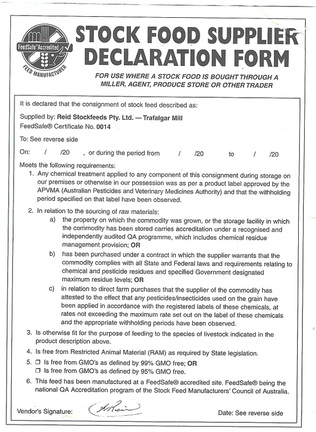
We do our best to ensure that our hens are not fed genetically modified products.
As you can see here, our chook food supplier guarantees that there are minimal GM contaminated grains in the feed he supplies to us.
It is impossible for anyone to 'guarantee' that there are NO GM products in the feed because the wind spreads seeds and pollen. Many grain crops throughout the world have been contaminated by the spread of GM contamination. No-one in Australia can give a 100% guarantee that their grains are GM free.
